Built for Asian Hotel Markets, Not Adapted for Them
Revenue management software has long been dominated by platforms built for European and North American markets, then stretched to cover Asia as an afterthought. We started from the other direction — designing every feature around the data realities, booking patterns, and demand drivers specific to Singapore, Hong Kong, Japan, South Korea, and Southeast Asia.
Hotelinsight gives independent hotel teams practical revenue guidance by connecting property performance with competitor pricing and primary-source tourism data from across Asia-Pacific.
Continue exploring
Data Philosophy
- Primary Sources Only: Every market data point traces back to an official government agency — Singapore Tourism Board, HKTB, Japan's MLIT, JNTO, or Korea Tourism Organization. We never synthesize, estimate, or proxy official data.
- Full Historical Depth: We maintain complete archives: JNTO arrivals from 1996, Singapore hotel stats from 2010, MLIT accommodation surveys across all 47 Japanese prefectures. Long time series reveal patterns that short-window tools miss.
- Live Signal Integration: Static historical data alone doesn't move rates. We layer real-time flight volumes, forward event calendars, holiday proximity, and search trend momentum on top of official statistics to produce demand intelligence that's actionable today.
- No Black Boxes: Every rate recommendation includes the specific signals that drove it — demand score, pickup velocity, occupancy position, rate index, events. Revenue managers see exactly why the system recommends what it does.
Why These Five Markets?
We chose markets where official data quality is high enough to build reliable demand intelligence — not where it would be easiest to launch. Each market was evaluated on the depth, frequency, and commercial licensing of its government tourism data.
- Singapore: STB's transparent monthly data pipeline and Singapore's role as Asia's gateway market made it the natural starting point.
- Hong Kong: HKTB data covers overnight stays, same-day visitors, and cross-border arrivals — capturing nuances that pure air arrival data misses.
- Japan: MLIT's prefecture-level accommodation surveys and JNTO's expenditure breakdowns are the most granular official hotel data in Asia.
- South Korea: KTO data captures nationality-level arrival shifts driven by K-culture trends — a demand driver not well-modeled by generic systems.
- Southeast Asia: Five-country coverage enables multi-market benchmarking for hotel groups with regional portfolios.
Turning Data Into Revenue Decisions
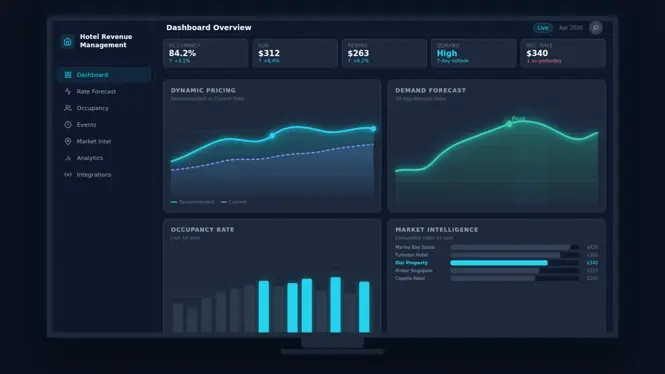
- Composite Demand Scoring: A single 0–100% demand score per future date, blending sold-out rates, search trends, flight volumes, events, holidays, and rate index position.
- AI Rate Recommendations: Daily increase / hold / decrease guidance for every future date, with the specific signals behind each recommendation fully disclosed.
- AI Visitor Forecasting: 12-week forward arrival forecasts powered by historical government data, flight bookings, holiday calendars, and event schedules.
- Flight & Event Intelligence: Real-time inbound flight volumes and a city-level events calendar updated continuously to surface demand surges before they hit.
- Market Benchmarking: Rate and occupancy benchmarking against 180+ competitor hotels per market, plus government tourism board benchmark data.
- Pickup & Revenue Analytics: Booking velocity tracking, cancellation revenue impact, channel adjustments, and room type performance — all in one dashboard.
Roadmap
- Q2 2026
- Taiwan market data integration (Tourism Bureau of Taiwan)
- Expanded short-term rental supply tracking for Japan
- Property-level rate alert subscriptions
- Q3 2026
- China inbound travel recovery analytics
- Group booking demand forecasting module
- Automated rate loading via channel manager APIs
- Q4 2026
- India market coverage (MoT monthly visitor data)
- Enhanced AI advisor with scenario modeling
- Multi-market portfolio reporting dashboard
Contact
Email us at hello@hotelinsight.ai to discuss the platform, specific market data, or enterprise arrangements.
Explore our market coverage or read the latest analysis on the blog.